I have a small collection on the bottom shelf of my bookcase of important books. The books are: How Things Work (4 volumes), Roger Segalat, translated from German; The Way It Works, Robin Kerrod, 1980; The Way Things Work, translated from Italian, 1989; The Way Things Work, David McCauley, 1988; and two massive volumes on the history of science. That’s what people do – we figure out how things work, and use that knowledge to understand and manipulate the world around us.
A friend recently asked me, “What is the best argument that a lot of current climate change is caused by humans, through fossil fuel CO2, methane, and other green house gases? What are the best data and arguments?” The most important point about climate science is that we know how it works. It isn’t speculation or correlation. We simply know how it works. Since the 1860s or before, people have known that glass bottles filled with CO2 heat up faster than bottles filled with air. In 1896, the brilliant Swedish chemist Arrhenius calculated how much the earth would warm if CO2 concentration was doubled. This happened in the same decade that we invented the manual transmission and radio transmission of Morse code, and about a decade after Edison’s electric lightbulb. Scientific research has continued since Arrhenius, and we know how the CO2 greenhouse effect works just as well as we know how an AM radio, manual transmission, or incandescent lightbulb works.
We’ve observed and measured the processes that trap heat in the atmosphere and we’ve made predictions of future warming and related events. To confirm or deny the theory of global warming, scientists set up a system of instrumentation across the planet and in orbit, beginning about 30 years ago. The data are clear – oceans are warming from the surface downwards, ice is melting in every setting on the planet, and atmospheric temperatures are rising. We’ve seen the primary predictions of global warming and second-order climate changes robustly confirmed. Objections and challenges to the data and interpretation have been evaluated and refuted.
How It Works
The entire spectrum of electromagnetic radiation includes gamma rays, x-rays, ultraviolet, visible light, infrared, microwaves and radio waves. The high-energy end of the spectrum consists of very short wavelengths, including gamma rays and x-rays through visible light, while the low-energy end of the spectrum has longer wavelengths, from infrared through radio waves.
Everything radiates electro-magnetic radiation at some wavelength. It’s called by several names –Planck radiation, black-body radiation, or thermal infrared radiation. The kind of radiation emitted by objects depends on temperature. Hot objects emit high energy radiation with short wavelengths, and cool objects emit low energy radiation with long wavelengths. The sun primarily emits energy in the visible spectrum, because it is very hot. Atmospheric gases are transparent to the visible spectrum, so most of the sun’s energy passes through our atmosphere to reach the ground. Visible light strikes the earth’s surface and is converted to heat. The warmed earth also emits radiation, but at a longer wavelength (infrared) because it is cool. The earth’s infrared radiation mostly escapes back into space. Carbon dioxide, water vapor and methane, however, are partly opaque to infrared radiation, depending on the specific wavelength. These gases trap heat in the atmosphere, warming the air, the oceans and the ground. The phenomenon is called the greenhouse effect, because glass will do exactly the same thing, keeping a greenhouse warm – visible light goes in, but infrared radiation is trapped inside.

Image credit: Science News. The yellow lines are actual IR readings from space, compared to the theoretical Planck radiation from the ocean surface shown in dark blue. Depressions and divots in the yellow lines represent absorption of upgoing IR radiation by various greenhouse gases, notably CO2. Differences between the yellow lines represent clear and cloudy skies, with cloud tops having cooler temperatures and a different baseline Planck profile.
The natural amount of CO2 and water vapor in the air keeps the earth at a temperature to which we’ve become adapted. If the earth’s atmosphere had absolutely no CO2 or H2O, the earth’s average temperature would be about 33 C colder, causing freezing conditions over the entire planet.
Of the sun’s incoming radiation (341 W/m2), about 29% (100 W/m2) is directly reflected back into space, mostly by clouds. The remaining 241 W/m2 is absorbed by the ground and atmosphere, warming the Earth. The Earth radiates energy back into space at a wavelength in the infrared spectrum, balancing the energy input from the sun to create a stable climate for the past 6000 years. But the addition of greenhouse gases to the atmosphere is currently trapping 0.94% (3.2 W/m2) of the sun’s energy reaching the surface. That heat is ultimately redistributed to the oceans, ice, and air, warming the earth.
This figure simplifies many heat transfers within the atmosphere before energy is either retained on earth or returned to space. The heat retained by greenhouse gases is given the awkward technical term "radiative forcing".
[Technical note: The sun's radiation, measured in space, has an intensity of 1364 W/m2. There is a range of reported figures from 1361 W/m2 to 1368 W/m2, depending on the choice of instrument calibration. The earth receives sunlight according to its cross-sectional area, equal to one-quarter of its surface area. The earth emits radiation from its entire surface area. So for a simplified energy budget as shown below, we have to choose a convention of adapting numbers for the cross-sectional area or the surface area of the earth. Most displays adopt the convention of the whole earth surface area as I've done above. This requires dividing the sun's input radiation by four, yielding 341 W/m2 to represent the average energy input across the entire earth.]
Under natural conditions, a balance develops between the incoming and outgoing radiation, which keeps the earth’s temperature stable, unless disturbed by other factors such as orbital variation. The earth’s orbit varies over cycles of 40,000 years and 100,000 years, which triggers feedback mechanisms (including CO2 concentration and reflective ice) producing ice ages.
Climate-change deniers are fond of saying "The climate has always been changing." But since the last ice age, for the past 6,000 years, the climate has been stable, as proven by geological studies of sea-level, temperature-sensitive isotopes, and ice-sheet deposits. This is the entire period of the written record of humanity. The pre-industrial level of CO2 created a “Goldilocks” climate in which humans and nature thrived.
For the past 150 years, we have burned increasing quantities of fossil fuels – coal, oil and natural gas, and cleared or burned forests to create new farmland.
The CO2 emitted from these human activities has markedly changed the concentration of CO2 in the atmosphere, from the pre-industrial level of about 280 parts per million (ppm) of CO2, to the current level of 420 ppm CO2. Because CO2 is such a potent greenhouse gas, this small change in atmospheric composition has a marked change in retained infrared radiation.
You might not think that 400 parts per million is enough to change the retention of radiation in the atmosphere. I’d like to propose a small thought experiment. Four hundred parts per million is equivalent to four parts in ten thousand, or one part in 2,500. One ounce of water contains about 600 drops. Four and 1/6 ounces of water, about a half-cup, contains 2,500 drops. Imagine, for a moment (or really try) putting one drop of opaque India ink or dark food coloring into a half-cup of water. The ink noticeably reduces the visible light transmitted through the otherwise transparent water. It’s the same with CO2 in the atmosphere.
Climate Feedbacks
There are further processes known as feedback mechanisms affecting the earth’s heat budget. Feedbacks are processes that are triggered by changes in Earth’s temperature, which either amplify (positive) or diminish (negative) the primary changes. The strongest feedback effect is the Planck effect, a negative feedback. As the Earth’s temperature rises, it radiates energy more strongly, counteracting the influence of greenhouse gases. The balance between the sun’s incoming energy and the Planck effect is what caused the Earth to settle at a stable temperature. The second strongest feedback is water vapor. As the ocean surface becomes warmer, the equilibrium humidity in the air rises. Also, warmer air can hold more humidity, keeping additional water vapor in the air. Higher humidity is a positive feedback mechanism, because water vapor is itself a powerful greenhouse gas. So as the planet warms, more heat is retained by water vapor. As Arctic snow and ice melt, the surface reflectivity diminishes, causing positive feedback. Climate change increases cloudiness, causing feedback effects. Clouds are complex as a feedback mechanism, with both positive and negative impacts. Depending on the type of cloud, the primary impact may be to reflect sunlight, or may be to retain infrared emissions from earth. Overall, clouds are considered to be a positive feedback. There are more complex feedbacks involving biochemistry and methane, and fast versus slow feedbacks, but these are generally an order of magnitude less significant than the physical feedbacks. This is an area of active climate research.


The Planck effect dominates all other feedback mechanisms, and the total impact of all feedback effects is negative. This is very good, because a simple modeling exercise shows that the global climate would soon irreversibly blow up if the total feedback were positive. Nevertheless, there are number of authoritative sources on climate feedbacks (notably Wikipedia and Andrew Dessler’s Modern Climate Change) that neglect to mention the Planck effect among climate feedbacks and assert that the net climate feedback is positive. This is incorrect.
Global temperature change since pre-industrial times is about 1.1 C, so the current total feedback is -1.3 W/m2. Combining the greenhouse gas effect with total feedback leaves a positive (warming) climate influence of 1.9 W/m2.
Validation
Climate science predicts that the earth should be warming, due to heating resulting from the buildup of greenhouse gases. These greenhouse gases, particularly CO2, are unquestionably from human activities (see my blog post, https://dougrobbins.blogspot.com/2019/12/understanding-source-of-rising.html). We have detailed temperature records for much of the world for the past 150 year or so, and we have plentiful temperature measurements of the oceans beginning in about 1950. However, early climate data have a few issues with data quality and coverage.
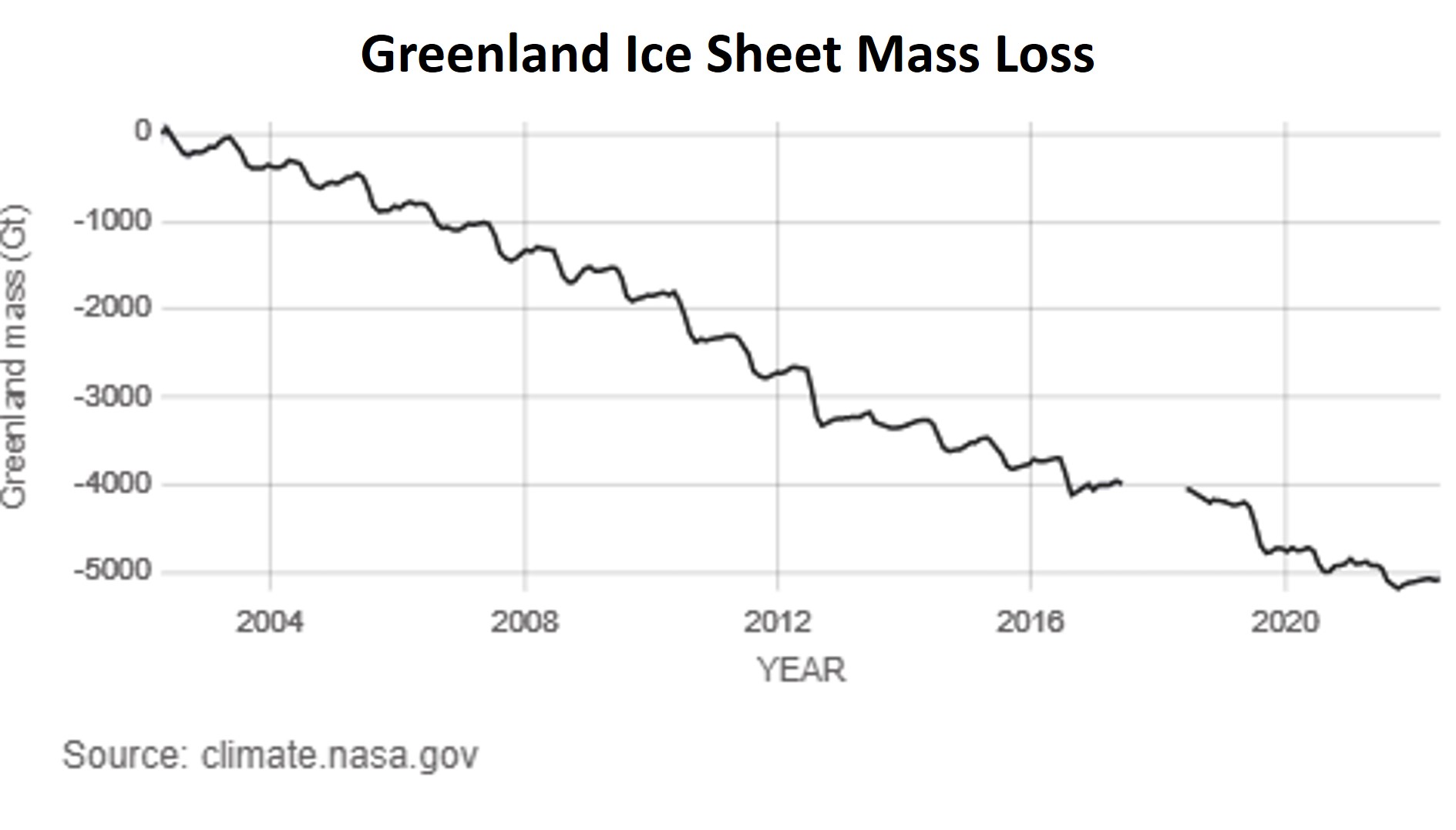
Starting around 1990, scientists put in place a comprehensive set of instrumentation specifically designed to detect and measure global warming. These systems have corrected some of the issues of data collection from early research, and provide unprecedented coverage of our planet. The results are unequivocal. The oceans are warming from the surface downwards; the air is warming over the oceans; the air is warming more rapidly over land; the Arctic is warming faster than the rest of the planet; and continental glaciers, Arctic sea ice, and the Greenland and Antarctic ice caps are melting. Other, second order effects of the heat are well-proven also, including an acceleration of rising sea level and seasonal changes in physical and biological systems.
There is simply no point to denying that global warming and resulting climate changes are happening due to human emissions of greenhouse gases. These changes are observed to be accelerating, as expected, due to higher concentrations of greenhouse gases. Previous predictions about climate change have been highly accurate. There is no reason to doubt further predictions of serious to catastrophic harm from future climate change unless we greatly curtail emissions of greenhouse gases.
Appendices
Appendix 1
Climate change indicators and sources
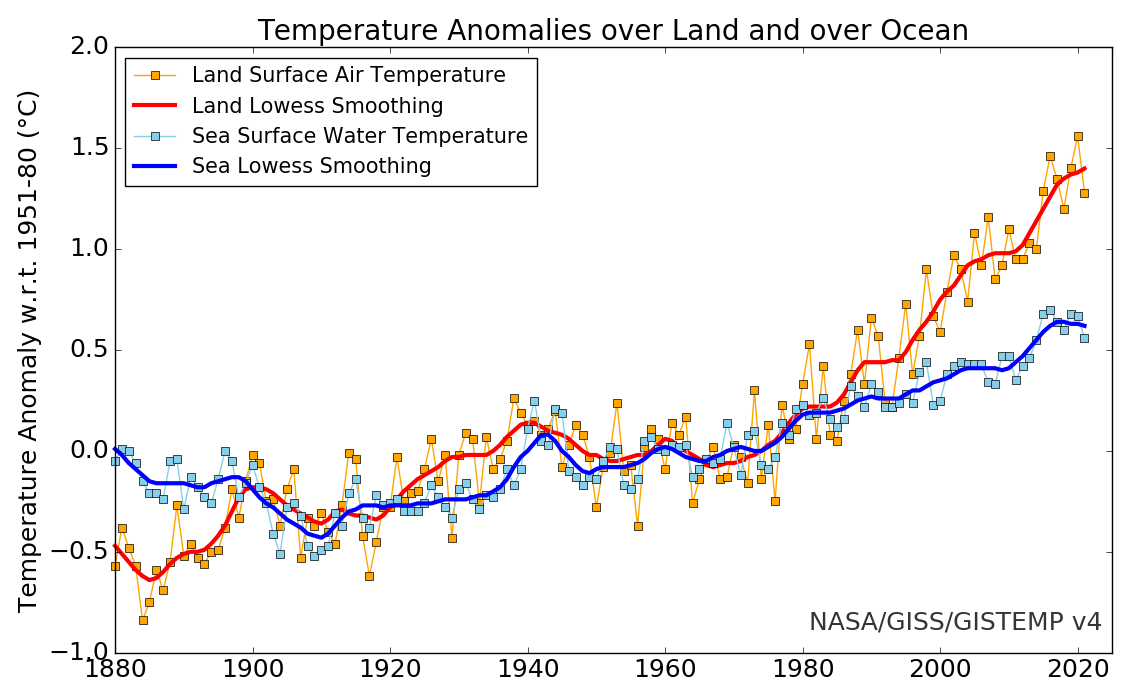
Air Temperature Over Land and Oceans
https://data.giss.nasa.gov/gistemp/graphs_v4/

Temperature Anomaly Map, 2016-2022 vs. 1951-1980
Note Arctic warming is more intense than the rest of the planet, as predicted by the Macdonald report in 1979. Also note that air over land is warming faster than air over oceans.
https://data.giss.nasa.gov/gistemp/maps/
https://climate.nasa.gov/vital-signs/ice-sheets/
Appendix 2, Comparison of Descriptions of Greenhouse Gas Heating
Arrhenius, 1896
“The selective absorption of the atmosphere is…of a wholly different kind [than diffusion of ultraviolet radiation]. It is not exerted by the chief mass of the air, but in a high degree by aqueous vapour and carbonic acid [CO2], which are present in the air in small quantities. Further, this absorption is not continuous over the whole spectrum, but nearly insensible in the light part of it, and chiefly limited to the long-waved part, where it manifests itself in very well-defined absorption-bands, which fall off rapidly on both sides. The influence of this absorption is comparatively small on the heat from the sun, but must be of great importance in the transmission of rays [thermal infrared, or long-wave radiation] from the earth.”
Arrhenius then describes the debate over whether water vapor or CO2 has the greater influence as a greenhouse gas.
Asimov, 1959
"The light rays of the Sun hit the air, pass through a hundred miles of it, hit the surface of the Earth, and are absorbed. The Earth heats up. The heated Earth radiates energy at night back into space, in the form of the far less energetic infra-red. This also passes through the atmosphere. The warmer Earth grows, the more heat is radiated away at night. At some particular equilibrium temperature, the net loss of radiation by Earth at night equals that gained by day so that, once the temperature (whatever it is) is reached, the Earth as a whole neither warms nor cools with time.
Carbon dioxide, however, introduces a complication. It lets light rays through as easily as do oxygen and nitrogen, but it absorbs infra-red rather strongly. This means that Earth’s nighttime radiation finds the atmosphere partially opaque, and some doesn’t get through. The result is that the equilibrium temperature must rise a few degrees to reach the point where enough infra-red is forced out into space to balance the Solar input. The Earth is warmer (on the whole) than it would be if there were no carbon dioxide at all in the atmosphere. The warming effect of carbon dioxide is called the “greenhouse effect”.
…A recent set of calculations indicate that if the present carbon dioxide level should double, the overall temperature of the Earth would rise by 3.6 C."
Asimov was reporting on the work of G.N. Plass, published in 1958.
Ramaswamy, 2019
“Interactions of the incoming solar radiation and outgoing longwave radiation with Earth’s surface and atmosphere affect the planetary heat balance and therefore impact the climate system.”
Also see:
Ramaswamy, Radiative Forcing of Climate Change, 2001
Ramaswamy, Radiative Forcing of Climate: The Historical Evolution of the Radiative Forcing Concept, the Forcing Agents and their Quantification, and Applications, 2019
R. J. Bantges & H. E. Brindley, On the Detection of Robust Multidecadal Changes in Earth’s Outgoing Longwave Radiation Spectrum, 2016
A. Dessler, Modern Climate Change, Third Edition, 2022
IPCC Reports, Technical Summaries, various dates.
Appendix 3, Discussion of Climate Feedback Discrepencies
Wikipedia asserts that there is a net positive feedback to warming. However, a check of the referenced IPCC Technical Summary for AR5 (2014) is less clear and does not explicitly mention Planck radiation, the strongest negative feedback. Andrew Dessler’s Modern Climate Change also concludes that total feedbacks are positive. Dessler also does not mention Plack radiation as a feedback parameter. [Dessler quantifies the total feedback relative to radiative forcing, rather than temperature change, which makes direct comparison of the feedback numbers a little more difficult.] On the other hand, Global Climate Models, by D.L. Hartman, clearly identifies each feedback component, including Planck radiation. Hartman states “the best estimate of the total feedback is about −1.2 ± 0.6 W m−2 K−1, but it is uncertain by about ±50%.” The IPCC AR6 preliminary Technical Summary also concludes that total physical feedbacks are negative, with a best value of about -1.2 ± 0.7 W m−2 K−1. I think that the value of -1.2 W m−2 K−1 is likely to be the best estimate.
References:
Svante Arrhenius, On the Influence of Carbonic Acid in the
Air upon the Temperature of the Ground, 1896.
https://www.rsc.org/images/Arrhenius1896_tcm18-173546.pdf
Isaac Asimov, "No More Ice Ages?", 1959
In Fact and Fancy, 1972
Ocean heat content, NOAA
https://www.ncei.noaa.gov/access/global-ocean-heat-content/
ARGO Ocean Temperature Program Homepage
https://argo.ucsd.edu/
NOAA Annual Greenhouse Gas Index
https://gml.noaa.gov/aggi/aggi.html
Lambeck et al, Sea level and global ice volumes from the Last Glacial Maximum to the Holocene, 2014
https://www.pnas.org/doi/10.1073/pnas.1411762111
Doug Robbins, atmospheric CO2 and related charts, 2022.
http://dougrobbins.blogspot.com/2022/04/charts-of-atmospheric-co2-carbon.html
NASA GISS Annual Mean Temperature over Land and over Oceans
https://data.giss.nasa.gov/gistemp/graphs_v3/
G. Macdonald, JASONs presidential science advisory report,
excerpt, 1979.
https://climatestate.com/2019/07/10/the-jason-report-the-long-term-impact-of-carbon-dioxide-on-climate-1979/
Whole report:
https://irp.fas.org/agency/dod/jason/co2.pdf
Dennis Hartmann, Global Climate Models, 2016 (feedback
chart)
https://www.sciencedirect.com/topics/earth-and-planetary-sciences/climate-feedback
IPCC AR6 Technical Summary (feedback chart, pg. 96)
https://www.ipcc.ch/report/ar6/wg1/downloads/report/IPCC_AR6_WGI_TS.pdf
Andrew Dessler, Introduction to Modern Climate Change, Third Edition, 2022