Rome Didn't Fall in A Day.


Objective Truth Exists and is Accessible to Everyone.

All Human Problems can be Solved with Enough Knowledge, Wealth, Social Cooperation and Time.


Photo: Rusty Peak, Anchorage, Alaska


Translate

Showing posts with label GDP. Show all posts

Wednesday, February 25, 2026

The Paradox of Productivity, Part II - The Player Piano Society

AI and the Future of Professional Employment
In my last post we learned that from 1980 to 2025, technology improved the productivity of employees, but reduced the number of good jobs and workers’ earning power.  Now, in 2026, people who are knowledgeable about the state of artificial intelligence are warning that worker replacement is about to happen on an unprecedented scale.  

This image of a robot playing a piano was generated by AI.  I'm aware of the irony here.

Writing in Fortune, Matt Shumer wrote of his own experience as an AI developer. 

“For years, AI had been improving steadily. Then in 2025, new techniques for building these models unlocked a much faster pace of progress. This year, something clicked. Not like a light switch… more like the moment you realize the water has been rising around you and is now at your chest.I am no longer needed for the actual technical work of my job….
The experience that tech workers have had over the past year, of watching AI go from “helpful tool” to “does my job better than I do”, is the experience everyone else is about to have. Law, finance, medicine, accounting, consulting, writing, design, analysis, customer service. Not in 10 years. The people building these systems say one to five years. Some say less.”  

A friend on social media wrote a very similar post within a day or two of the article above.  

"I piloted the expensive version of Anthropic's Claude this weekend and we're really screwed. Anyone pretending this can't replace the majority of mid-range paid work is living in a dangerous fantasy right now.
Careers on life support:
- Product Owner
- QA/test Engineer 
- Paralegal
- Data/BI Analyst 
- Copywriter  
- Content Editor
- Any role in IT Support
- Marketing whatever 
We're not mature enough a society to have this many people out of work"

Global spending on artificial intelligence in 2025 was about $1.5 trillion, increasing at a rate of about 50% per year.  These investments are largely justified on expected cost savings for businesses by replacing employees.  But at some point, I wonder what will happen to consumer spending when many good-paying jobs have disappeared.  

The economy is already showing signs of stress for lower-income Americans.  In 2025, overall consumer spending increased by 2.7%, a slight slowdown from the previous year, and declining in the fourth quarter. Lower-income consumers faced tighter budgets and rising debt.  Credit-card debt increased faster than inflation, at 5.5%.  Delinquencies on most categories of debt rose through 2025, and the personal savings rate has declined from 6% to 4% over the past two years. 

Impact on the Economy
As I explored in an earlier post about the book “Abundance”, many workers have been left behind in the economic development of the past fifty years.  Moody’s Analytics recently reported that households with the highest 10% of income account for 50% of consumer spending.  It is the logical response of the economy to wealth inequality.  Extreme wealth inequality has existed before; e.g., in the 19th century Gilded Age, or the pre-revolutionary French economy.  I do not know how our current disproportionate economic production compares to those early ages.  But if AI greatly increases the rate of destruction of white-collar jobs, there will be even stronger division between the haves and have-nots in America.

In recent months, the expectation of what AI can do has had a major impact on the job market and in stock valuations.  The job market for software developers rapidly surged immediately post-pandemic, and equally quickly collapsed, as the capabilities of AI became better known.  Stock valuations for traditional software makers, certain internet services, and employment agencies fell abruptly.  Yesterday, the leading AI company Anthropic made an announcement about coding abilities of its Claude AI, and the IBM immediately lost $32 billion in market capitalization.


In my economics classes, the professors confidently predicted that new technologies would always produce new jobs.  But that is simply an empirical observation about previous economic change.  It doesn’t necessarily hold for the future.  AI has the potential for faster disruption and more complete disruption than earlier technical revolutions.  And the people put out of work by AI will not necessarily have the skills to take new jobs, if they appear.  

I’m not a Luddite.  I see no point of continuing jobs after they have been rendered obsolete.  The history of railroad employment is an example.  In 1920, there were about 2 million railway workers in the U.S.  By 1959, the number had declined to 780,000, and today, only 153,000 workers are needed to run our trains.  Around 1960, labor contracts forced railroads to continue employing workers that were unneeded due to more modern train technology, such as coal shovelers on diesel trains.  The unnecessary workers cost the railroad industry about $500 million per year, or about 5% of total profits.  

It seems to me that AI is necessarily derivative from training sets of human-generated content.  As such, AI is simply not capable of genuine creativity and innovation.  AI does have the ability to synthesize, and make connections between bits of information that a human would miss.  But, although I am no expert about AI, it seems that AI will probably not recognize new phenomena, or invent new processes for businesses.  And without creativity, technology may stagnate.  Or, perhaps AI, acting as an assistant, may give more scope to  human inventors.  Time will tell.

Artificial intelligence is necessarily derivative from training sets of human origins.  While AI may be capable of bringing ideas together in synergy, AI itself is likely to lag behind humans in terms of innovation and creativity.  

But I do believe the providing good jobs is part of a social contract between businesses and society.  Business profits should be measured as a function of how many well-paying jobs the business provides and taxed accordingly.  If the business provides well-paying jobs, great; it is fulfilling its social obligation.  If not, government can use the taxes for employment-directed programs for the public good or for job-training.  

I recently saw a conversation thread on the Reddit website.  A fellow working as a Lyft driver argued that new technology always creates new jobs.  It occurred to me that perhaps he could have had a higher-paying job if jobs had not been eliminated by new technology. Further, the job of a Lyft driver might be one of the first jobs eliminated by AI.  It just seemed to me that he hadn’t thought about the problem all the way through.

If the replacement of well-paying jobs is as extensive as expected, what will happen to consumer spending?  As noted above, half of the economy is already serving the top 10% of households by income.  What will companies make and sell when the bulk of consumers cannot afford to buy products?

 A player piano is often used to symbolize the replacement of humans by machines, as seen in the introductory title sequence in Westworld.  Kurt Vonnegut’s first novel, “Player Piano” envisioned a world where machines had replaced nearly all human labor.  Rather than a utopia, it was a dystopia, with 98% unemployment, and only a lucky few able to find meaningful work.  Wealth distribution was greatly unequal, and did not allow most citizens to engage in uneconomic but enjoyable pursuits.  It remains to be seen whether AI will create a society with better employment and more equitable wealth distribution, or whether we will have some version of the Player Piano society.  

References
https://www.bls.gov/emp/tables/employment-by-major-industry-sector.htm
https://www.bls.gov/emp/tables/real-gdp-major-demand-category.htm
https://fortune.com/2026/02/11/something-big-is-happening-ai-february-2020-moment-matt-shumer
https://www.marketplace.org/story/2025/09/17/top-10-of-earners-make-up-half-of-us-retail-spending

Player Piano, Kurt Vonnegut, 1952, 353p.


Monday, February 16, 2026

The Paradox of Worker Productivity, Part I

 In my recent review of the book “Abundance”, I wrote, “…government should help to improve [workers’] productivity and value to employers.”  Implicit in my thinking was that if workers became more productive, companies would hire more workers and pay them more.  A day or two later, I realized that my own career history completely contradicted that idea.

I worked for 26 years for a large corporation.  I spent about 15 years in middle management supervising professional-level employees.  Around 1990, I attended a company-wide managers’ meeting.  At that meeting, the VP of Human Resources gave a presentation laying out his vision of the future company.  At the time, the company employed about 3000 professional employees.  The HR manager said that thanks to productivity improvements, the company could be run with fewer employees and maintain the same level of production.  He said, within the decade, he expected that the company would reduce professional head-count by 2/3, to 1000 professionals.  And he added a stretch goal of reducing head-count to 300.

Employees are expensive.  Employees require salary and office space.  Employees require benefits.  Thanks to union negotiators, my company provided excellent benefits, including a pension plan, matching 401k plus excellent health insurance, which was guaranteed after retirement until age 65.  For the company, employees involve potential liability for injuries and occupational discrimination or sexual harassment lawsuits.  If an employee can be replaced by a widget, there will be potential cost savings, and my company took that as a guiding principle for four decades.  

Throughout my career, technology increased employee productivity.  Rather than creating the opportunity for more value by adding employees, technology simply meant the company could be run with fewer employees.  A manager with a PC no longer needed a secretary.  A geologist with a workstation replaced three geologists using drafting tables.  Information specialists were replaced by computer systems.  Workstations produced presentation-quality documents, so draftsmen and reprographics specialists were no longer needed.  Accountants were replaced by enterprise-wide software.  As people were replaced across the entire industry, they competed for the diminishing jobs and could be paid less.  Or at least, paid no more than before.

The same story was repeated across the whole corporate economy since 1980.  Technology means that businesses can be run with fewer employees, and fewer employees mean lower costs.  

So that is the paradox of productivity.  Technology and capital make employees more productive, but create a surplus of available employees.  Rather than creating more jobs and higher compensation, technology means lower employment and lower pay. 

The preceding paragraphs describe the American economy from 1980 to 2025.  Statistics show that employment increased at a compounded rate of 1.2% per year from 1960 – 2024, while real GDP increased at a compounded rate of 2.5%.  As noted in my blog post on “Abundance”, employee earnings have stagnated over the same period.

Conclusion
In my economics classes, it was a truism that new technologies always create new jobs as it destroys old ones.  This was the pattern of the industrial revolution and the automobile revolution.  Economist Joseph Schumpeter gave it a name: creative destruction.  But there’s no reason why this should always be so.  It’s simply an empirical observation.  Empiricism is always limited to prior experience and is not necessarily true in future circumstances.  In any event, the new jobs may not appear in a timely fashion, and workers whose jobs are eliminated may be unable to be trained for the new jobs.  

The human cost of technological disruption is real.  As a corporate manager, I survived a dozen rounds of layoffs myself, and was forced to lay off friends and long-time colleagues on more than one occasion.  

New technology enables higher worker productivity.   The paradox of higher worker productivity is that as individual workers become more valuable to the company, corporate profits rise, but workers suffer job losses and lower pay.  


Tuesday, December 12, 2017

Corporate Taxes and the 2017 Republican Tax Reform Plan

The Republican-controlled Congress is in the final stages of writing the most sweeping tax changes in forty years.  The Senate version of the tax bill is 487 pages, which is hardly the sweeping simplification promised by Republicans, and too long to easily summarize in this paragraph.  Business taxes are affected far more than individual taxes. Specifics of the tax bill are summarized at the end of this article.

The main focus of the tax reform is lower taxes for corporations.  The pretext is that lower taxes on corporations will result in economic growth, but the real goal is to lower taxes on unearned income.  Profits saved through lower taxes will flow through corporations to shareholders, including Republican Party donors.  The expectation of higher dividends and capital gains has driven the stock market by more than 25% since the election.

Most, if not all, serious economic reviews of the tax plan do not support the expectation of higher economic growth.  The Congressional Joint Committee on Taxation concluded that the bill would only add marginally to economic growth, while adding one trillion dollars to the US Federal debt, even after accounting for the additional tax revenue resulting from growth.  And both private and JCT analyses conclude that tax benefits will accrue to the wealthiest Americans, with poorer Americans losing money.
--
Justification for 2017 Corporate Tax Cut
The rationale for the deep cut in corporate taxes is based on the idea that higher after-tax profits for corporations will result in a higher rate of economic growth.  Also, the argument is that a higher rate of growth will be shared by wage-earners in the form of higher take-home pay.
Let’s look at that idea.

United States Corporate Taxes Compared to the OECD
In justifying the corporate tax cut, both of Alaska's Senators have said that American corporate taxes are "among the highest in the world".  They believe those high taxes render our corporations noncompetitive in global markets. As this blog has previously noted, a quick trip to the OECD database shows that idea is simply false.  Although US nominal corporate taxes are comparatively high, the corporate tax actually paid in the United States is less than the average for the OECD.   
GDP Growth, Corporate Taxes, After-Tax Profits and Wages
The premise that higher after-tax corporate profits lead to higher economic growth and higher wages is false.  American economic growth has been declining since World War II.
This is especially evident when we look at non-recessionary periods.  This chart has deleted all quarters with negative GDP growth.
Wages have declined since World War II, as a share of gross domestic income, GDI (or similarly, GDP).
Let's look at Corporate After-Tax Profits.  We can see that profits have soared since the 1980s as a share of GDP.  Higher corporate profits since 2004 (excepting the recession year) have not produced higher GDP growth, or higher wages.
Corporate taxes have also fallen as a percent of GDP, coincident with a falling rate of growth.
But the rise in After-Tax Profits has not resulted in a higher rate of economic growth, or higher wages for workers.  The argument that lower taxes will result in higher economic growth appears to be void.
--
Tax Cuts and the Reagan Economy
The final argument for tax cuts is that tax cuts worked in the past.  The basis for that claim is generally in the mythology surrounding tax cuts enacted in 1981 and 1987 during the Reagan administration.  Close examination proves that economic growth during the Reagan administration was not extraordinary, and the growth that did occur was largely due to other factors. The actual performance of those tax cuts is complicated by eleven tax hikes that were also passed during the Reagan years, for the purpose of restoring lost revenues.

Let’s look at the Reagan economy.
First, the “economic boom” of the Reagan years looks less spectacular when viewed in the context of the total post-war economy.  American economic growth has been falling steadily since World War II, part of a general structural problem in the U.S. economy, reflected in GDP growth, wages as a share of the economy, and the time required for recovery after recessions.  [That should be the topic of another blog post.]  There were really only two years during the Reagan administration that had economic growth above the long-term, non-recessionary trend (1983 and 1984). 
Still, the Reagan administration was marked by a period of fairly persistent and strong growth.  There are three reasons for that growth. 
1)      Interest Rates
I believe that the main reason for sustained growth during the Reagan years was falling interest rates.  Interest rates reached a singular, extraordinary peak in 1981 (see chart).  The Volcker Federal reserve had largely quelled inflation by 1981, and began to let interest rates fall.  The extraordinarily high interest rates at the peak probably caused the multiple recessions of 1980 – 1982.  As interest rates fell, economic growth which had been bottled up by high rates was released.  I believe the influence of falling rates far exceeded the influence of lower taxes.
2)      Serendipity
Secondly, there is simply the matter of good timing.  The Reagan administration was faced with recessions in 1981 and 1982, but afterwards enjoyed the benefit of the typical eight-to-ten year business cycle.  There is no particular policy which can be attributed to this aspect of success, except luck.  [See previous chart, with indicated recessions.
3)      Tax Cuts
Tax cuts do provide stimulus to the economy, and the Reagan tax cuts of 1981 were appropriately given during an economic recession.  Ultimately, though, tax cuts are literally borrowing against the future, and must someday be paid back in terms of later economic growth.  I believe that it is best to run budgetary surpluses when there is strength in the economy, to allow the government the ability to incur deficits when the economy is weak, without fear of destabilizing the economy.  The Reagan administration never fully funded the government to pay for the deficits it incurred.

The 2017 Republican Tax Reform Plan
The Republican Tax Plan passed by the House and the Senate must now be reconciled into a single bill.  The bills are very similar in scope, and the process should not result in significant changes to the plans, except where major errors are discovered in the assumptions and provisions of the bill. 

My main objections to the plan are as follows:
1)      Debt
The plan runs large federal deficits, at a time when the total Federal debt is approaching 100% of annual GDP, and interest payments are starting to become a significant part of annual spending.
2)      Timing
The plan cuts taxes at a time of full employment, when fiscal policy should be to run surpluses.  
3)      Corporate Taxes
The plan awards long-term tax relief to corporations, at a time when corporate taxes are already low; corporate earnings are already soaring, and no gains in GDP have been observed.  
4)      Lack of Middle-Class Tax Relief/Benefits for Unearned Income
Individual tax relief in the plan will accrue mostly to high income families, particularly those with unearned income.  The corporate tax reduction will flow through to investors, much more directly than to wage-earners.  The plan will not result in long-term tax relief for wage-earners, whose share of gross domestic income has been falling for 47 years.
5)      Abolishes ACA Individual Mandate
The tax plan eliminates the individual mandate aspect of the Affordable Care Act.  It is considered an important facet of the act, in encouraging younger people to participate in the insurance pool.  

Conclusion
The Republican tax plan is based on false ideas:  that American corporate taxes are higher than other countries; that higher corporate taxes produce higher economic growth and higher wages; that general tax cuts during the Reagan administration produced extraordinary growth.  All of these ideas can be demonstrated to be false, using economic data that is available to anyone.

Lower corporate taxes increased profits, not wages.

The Republican tax plan will probably become law.  I expect that it is unlikely to survive the next administration and Congress.  But the debts incurred before it is overturned will last for a generation.

A copy of this post is available on my political blog, http://debatablypolitical.blogspot.com/.
------
Appendix
Summary of Important Changes in the Republican Tax Reform Bill
Business Tax Changes
1) Drops the nominal corporate income tax rate from 35% to 20%.  The current Senate bill, perhaps through an oversight, keeps the minimum corporate tax at 20%, eliminating exemptions by default.  It is expected that the reconciliation bill will restore those exemptions, dropping the actual corporate rate below 20%.
2) The tax rate for “pass-through” small businesses is reduced, excepting service businesses such as lawyers, accountants, and doctors.  The amount of the reduction is to be determined in reconciliation.
3)  Rules for expensing, rather than capitalizing, spending are relaxed, allowing quicker realization of tax benefits from business investment.
4)  Repatriated profits from foreign operations would be taxed at a much lower rate than US profits.  Cash assets would be taxed at 10% (Senate) or 14% (House), while non-cash assets would be taxed at 5% (Senate) or 7.5% (House). 

Individual Tax Changes
5) All classes of individual taxpayers will see a tax reduction in the near term, but those reductions will expire in ten years.  On the other hand, business tax reductions will be permanent.
6) The standard deduction is doubled, but personal exemptions are eliminated.  Child tax credits are increased, but the full value is only available to those with higher income to offset taxes.  For large families, the child tax credit may not fully offset the loss of personal exemptions.
7)  State & local tax deductions are eliminated; casualty loss deductions are eliminated.  The mortgage interest deduction is retained for all but the largest mortgages.
8) The estate tax may be eliminated, or the minimum threshold for the estate tax may be doubled.
9)  The individual mandate tax of the ACA is repealed.  Some fear that this will destabilize the insurance markets, by removing a large number of younger, healthy individuals from the insurance pool.
10) The fate of the Alternative Minimum Tax will be determined in reconciliation.
11) Waived tuition, common for graduate students, will now be taxed.  Colleges with very large endowments will have some earnings taxed.

Other
12) Drilling will be allowed in the Arctic National Wildlife Refuge Area 1002, which was originally set aside for consideration for oil development.
--
Appendix 2

As this blog has previously noted, American Federal taxes are among the lowest in the world, in direct contrast to Republican claims that American taxes are among the highest in the world.  Here is data from OECD and the World Bank, showing the relative ranking of American Federal taxes compared to other countries.  

United States Federal taxes as a share of GDP, compared to 34 OECD countries.
United States Federal taxes compared to 123 other countries; data from World Bank.
Countries with lower Federal taxes than the United States are Ethiopia, Pakistan, India, Afghanistan, Bangladesh, Central African Republic, West Bank and Gaza, Lithuania, Oman, Nigeria, Bahrain, Estonia, United Arab Emirates.
--
References
Summaries of the Republican Tax Plan
Washington Post
Forbes
CNN

Economic Reviews of the Tax Plan
Tax Policy Center – the plan will ultimately raise taxes on more than half of Americans.
University of Chicago Survey – only one out of 42 economists believes that the plan will significantly grow the economy. 
University of Pennsylvanian/Wharton review – the tax plan will add about $1.3 trillion to the national debt.

This article attempts to put lipstick on a pig.  The article acknowledges that economic growth from the tax plan will be small, “but significant”.  The article recognizes that slower growth has occurred in the past two decades, when progressively slower growth has actually been going on for seven decades.  The article gives no explanation for why growth is slower now than in the past, or why tax cuts at a time of full employment will help. 

A Federal tax expert says that the tax plan is stupid.

Historical Data
OECD tax on corporate profits
US corporate tax among the lowest in the OECD

Corporate Tax as share of GDP

Source of federal revenue

FRED

Friday, August 26, 2011

The Wealth of Nations

In my first two posts, I compared Per Capita GDP to oil consumption, and then to the Corruption Index published by Transparency International.  In this post, I will improve and combine those themes.

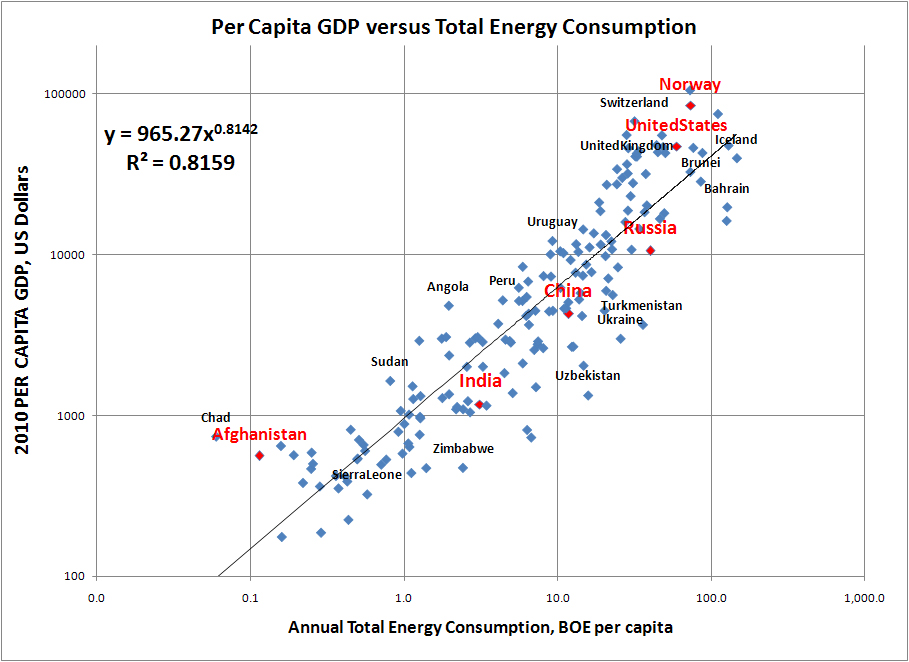
Productivity requires energy.  Every productive activity requires energy:  to extract resources; to change those resources into products; to transport workers to the place of work; to transport products to market; to move water for crops; etc.  So it is not too surprising that nations with higher energy consumption have higher GDP per capita.  Here is a chart showing GDP per capita vs. total energy consumption per capita.   In my earlier post, I used only oil consumption per capita, but analytically, total energy consumption is clearly a better choice.


  Another interesting correlation is to plot GDP per capita vs. the Corruption Index of Tranparency International.    Here's the chart:


There is greater scatter in the Corruption chart than the Energy chart, and the R-squared correlation value is lower.  Still, the relationship is clear and undeniable.

The converse of Corruption is Integrity.   To keep the parallelism with Energy, which has a positive relationship with GDP, I will use the word Integrity to define the second parameter.

As an aside, I should mention that correlation does not prove causation.  That is, we are likely to conclude that nations with high integrity have high GDP because their businesses and government use energy more efficiently.   Direct costs of the Enron fraud approached $50 billion; indirect costs are clearly substantial.   (http://en.wikipedia.org/wiki/Enron_scandal)  Losses from the housing/banking crisis of 2008 are orders of magnitude higher.   The crisis had its roots in corruption at multiple levels: brokers and appraisers fraudulently elevating home prices; lenders using gimmicks and fraud to write loans to people who could not afford them; banks aggregating toxic loans for sale to third parties; rating agencies issuing "A" credit ratings to toxic debt, because of financial interests in the issuing organizations.  Banking losses topped $2.8 trillion (and continue to grow); retirement assets lost $10 trillion.   Total US household wealth fell by $14 -trillion.  These market-value values might overstate the losses, but US real GDP declined by over $500 billion annual through 2008 and 2009.   Economies also suffered globally, by perhaps 4%, or about $2 trillion of lost productivity.  (http://en.wikipedia.org/wiki/Late-2000s_recessionhttp://en.wikipedia.org/wiki/Global_GDP).

Alternatively, we might also conclude that integrity is a luxury that only people living in a wealthy society can afford.   I believe that both of these relationships are partly true.

What happens if we combine these factors?   I used the trend-line regression feature available in Excel charts, and created an equation combining the influence of Energy and Integrity on Per Capita GDP.  With trial and error, I found the best result by weighting Energy by two-thirds, and Integrity by one-third.   Here's the equation:

GDP =  0.67 (965*BOE 0.8142) +  0 .33(406*e0.5839*Corruption Index)/2

It looks complicated, but the odd numbers are simply correcting for different units of measure.  Essentially, this equation just says that Energy consumption is twice as important as Integrity in determining a nation's GDP.  The graph is easier to understand.


Simplistically, R-squared represents the fraction of observed variance that is explained by the model (note that R-squared values for different variables do not add meaningfully!).  The Integrity factor alone explains about 60 percent of the variance of Per Capita GDP, while Energy alone explains about 80 percent of the variance of GDP.  Combining the factors in a single model improves the fit to the data to an R-squared value of about 0.88, explaining 88% of the variance in Per Capita GDP.  

The wealth of a nation depends primarily on its energy consumption, and secondarily on the intrinsic integrity of that society.   Other factors, such as democracy, free enterprise, the rule of law, and private ownership of capital are either secondary factors, or correlated with energy consumption and integrity.  I will now sit by the telephone waiting for the Nobel Prize in Economics.

http://www.measuringworth.com/datasets/usgdp/result.php

Thursday, December 30, 2010

Oil Consumption and Productivity

Plotting GDP per capita versus oil consumption per capita shows how much wealth is being created in different countries, and the efficiency with which they do so.   It is interesting that almost all countries plot below an "efficient frontier" indicating a ratio of productivity to oil use.   Despite major efforts in some countries (think about the number of bicycles in Holland) few countries are more than marginally more efficient at using energy than the United States.

Wednesday, December 15, 2010

Corruption vs. Per Capita GDP

Transparency International publishes a corruption index, quantifying the badness in every country.  Plotting against Per-Capita GDP shows that corruption in society, or conversely, integrity, is one of the main factors determining the wealth of an economy.   I will be waiting by the telephone for the Nobel Prize in Economics.